The perfect system for all DIY riders and aspiring dressage enthusiasts.
Dressage from a Thinking Rider’s perspective
Thinking Rider + Thinking Horse

Only 5-14% of riders learn best kinaesthetically (by primarily doing it first) yet the majority of talented-riders-turned-professional-trainers are kinaesthetic learners and they teach the way that THEY learned - by only instructing WHAT to do without explaining the HOW or WHY.
According to the Social Science Research Network, up to 65% of learners are Visual/Spatial Learners (learn best through illustration, demonstration, and explanations that lay out the system in a way they can “see”) and the remaining 30% are Logical and other style learners (learn best by understanding the system in a logical “if A, then B must follow” structure). These types of learners need to understand the why and how before they can “just do it.”
So... What is the secret to being a Thinking Rider when everyone tells you to just “Shut up and Ride”?
…especially when Riding and Learning are your Passion…
…or you feel like a misfit in the world of Dressage.
It’s time to step away from the “beating your head against the wall because it never gets any better” lessons... for good.
It’s time to say...
“What?!!! Are you kidding me?” to those who tell you to stop thinking stop asking questions and just do what you’re told to do (a.k.a. “Just shut up and ride.”)
It’s time to...
listen to your gut intuition that has been SCREAMING at you (or maybe only whispering perseveringly) that there is not just one way to learn how to ride and what you have been trying is NOT the way for you.
It’s time to think again about following advice that is CLEARLY not working for you (They teach what worked for them, but just because it worked for them does not mean that it is the only approach and it certainly does not mean that it is automatically the best approach for you).
It’s time to HONOUR your skepticism when you ask a question and it is answered with “word salad” (as in lot of fancy sounding words strung together, but you walk away feeling even MORE confused rather than feeling like it gave you the clarification and understanding you crave.)
Some of you reading this might be saying…
“Oh thank God! If I have to take another lesson where the same dressage-isms are spouted over and over, without ever answering any of my questions, I might just scream from frustration…”
Others of you might be thinking…
“Well, those lessons are designed that way for a reason. That is how people learn how to ride and train their horses, Right?! How can you learn to ride without doing what everyone else is doing?”
The problem is that it is NOT working. It DOESN’T work for everyone. And it is definitely NOT working for you.
(If you had known that learning to ride dressage would be this exasperating, you would have taken up gardening or golf!)

This is exactly what I found myself saying 25 years ago.
No matter how I tried to rephrase my questions, they were met with sighs and the, “you did NOT just ask me another question, did you?” sort of look. I thought there was just something wrong with me that I needed to know the answers to these questions before I could do ride it. Maybe you feel the same way.

Maybe you’re tired of scavenging
through all the many articles, blogs, videos, and posts online to find a system that will work for you and your horse
Maybe you’re confused
at all the conflicted advice and information out there. What is right? What will work best for YOUR horse?


Maybe your horse doesn’t trailer well
so you feel like you are stuck trying to figure it out yourself at home.
Maybe you’re on the brink of giving up
because no one seems to speak a “Dressage language” that can be translated to YOUR riding.


Maybe you feel unheard or misunderstood
because no one can (or is willing to) answer your questions, and they just give you “that look” when you ask yet another question.
Maybe you are isolated
and don’t have access to good instruction within many driving hours.

After riding with a variety of trainers, some of whom were incredibly talented riders, but they were unable to explain what they did, why they did it, and how to do it in a way that could be translated to my own riding…
And after being humiliated by trainers who believed the way to exert their dominance over me was to make me feel stupid for asking the questions I asked…
I almost gave up.
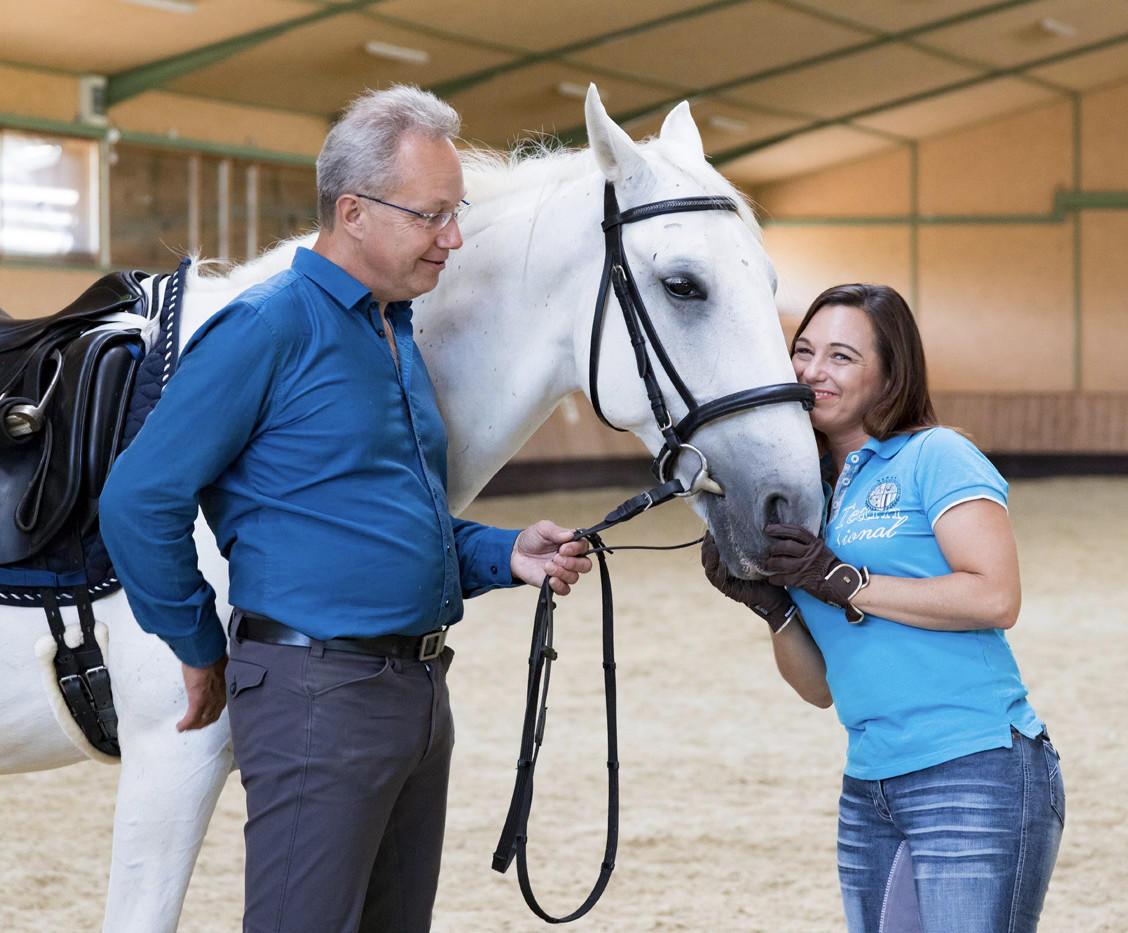
Until one day Thomas and I met each other,
and we discovered we were kindred spirits. We both had the same passion for riding, thirst for knowledge and answers, and unwavering perseverance to uncover the answers to the questions we had.
We joined forces and pursued our ongoing riding education together. We found trainers who were able to explain some of it, and together we hammered out a system that tied it all together.
We both came at it with a different set of inherent talents, but we brought these together to develop a comprehensive system that tied classical principles into biomechanics and was immediately applicable to all riders and horses. This was our breakthrough.
I started in the dark, not sure how to improve on basics taught years ago but knowing there was 'more to it'. I can't believe how much I have learned from Thomas and Shana. I now have the building blocks to work with any horse, not just mine. The improvement in my own horse is measurable. I am so motivated to ride and explore every single day. Massive thank you. I no longer go round in circles with no purpose.
- Ann Savage, Lincolnshire, UK

"I hear what you say but I don't understand what you mean"--this has been the thought in my head for years now during different classes by different instructors. Until I found the online course on the "what, why and how" by Shana and Thomas Ritter. Who would have thought that you can improve your riding ONLINE? Yes, you can. Based on a strong fundament of theory, flanked by teaching videos, an interactive Facebook group and weekly live Q&As this course is real gem. Now I understand what happens while riding and I am equipped with the tools to improve it.
- Anja Schröder, Germany
If you've ever felt "stuck" in your riding or teaching, this course is the answer. The Ritters combine theory with practical application for all stages of riding. A great aspect of the instruction is that one can see how a movement or concept applies up the levels of riding. This perspective has helped "unstick" our riding and we have made great progress in a short amount of time. This is also a great resource for instructors who need different ideas for teaching. I'm so glad I took a chance on this course!
- Julie Graber, Indiana USA
Thomas wrote about this system in his first book, "Dressage Principles based on Biomechanics,"
and over the next few years he fleshed it out even further through teaching the concepts in his clinics all over Europe, Canada, and the US.
In sharing these concepts in his lessons, he was able to define the core elements that all riders needed to know in order to successfully train their horses. In the process we witnessed first-hand how these concepts and this system was able to dramatically improve the lives and training success of thousands of horses and riders.
Eventually this was developed it into what we now call
"The What, Why, How Method".

We were teaching The What, Why, How Method in our clinics but we with only being able to teach a finite number of hours a day, we were limited in the number of people we could help. We had requests from all over the world to come teach clinics, but with a finite number of weekends in a year, we could not accommodate all of the requests.
That is when we decided to develop the system into an online course where we could teach the concepts and method to many riders all at once, regardless of which continent they lived in and regardless of their ability to get their horse to a riding clinic.


Imagine finding concrete answers to your training questions - that actually make SENSE and WORK.
Imagine finding a solution where all the pieces actually worked together in one complete holistic system, not an assembled mess of disparate techniques and “Dressage-isms” that don’t really work together well.
Imagine never having to start over again because you went down another detour that initially looked like it could be THE solution but didn’t pan out, or didn’t translate to results for your riding.
Imagine dramatically reducing the frustration for you AND your horse because you are no longer contradicting your training with techniques that don’t work together holistically.
Imagine jumpstarting your progress because you have a clear path and system to follow that lays out the entire training process for you in a methodical, straightforward manner.
Imagine the joy of greeting your horse who nickers at you happily when he sees you because he is excited and eager to experience what the day’s training session will bring.
Imagine the satisfaction of having the clarity and confidence that comes from being able to solve your own training problems, yourself, because you understand how it all works together (and even being able to help others with their training problems!)

The What, Why, How of Classical Dressage Training
New Course begins on January 22, 2024
A 4-Level Program that takes you from “banging your head against the wall” frustrated to confidently understanding how to use biomechanics-based exercises and the What, Why, How Method to train your horse.
The perfect system for all DIY riders and aspiring dressage enthusiasts.
Avoid past mistakes so you keep a steady rate of progress in your training

(no more wasted time on endless plateaus or dead-ends)
Jump-start stalled progress

(because you finally have answers to the questions you always had)
Surpass your perceived limits

(no more assuming you are not cut out to be the rider you always wanted to be - the one your horse needs you to be)
Achieve greater harmony and enhanced communication with your horse

(when your aids and intentions are clearer, your horse can understand what you are trying to say, and vice versa, when you can interpret your horse’s responses better, you have more accurate information to work with)
You’ll learn the Gymnastic Training of the Dressage Horse:

TIMING OF THE AIDS
Give your aids at the exact timing that will have the best influence on the horse (so you’re not just wildly guessing and hoping for the best)
HOW TO HALF-HALT
Understand exactly how to half-halt to achieve exactly what you aim to accomplish (no more wondering if you’re doing it right)
EFFECTIVE AIDS
Give a half-halt that goes “through” and know how to correct it when the horse doesn’t respond appropriately to the half-halt (no more disappearing half-halts, no more ignoring your aids)
ARENA GEOMETRY
Use the arena geometry in a way that facilitates the development of the training (so your riding makes interesting use of the natural geometry of the arena)
CORNERS
Use corners as the perfect gateway to every other movement (no more wasted opportunities)
TRAINING STRUCTURE
Structure your training sessions so that you guide the horse through the right sequence of elements in a ride (so you know what to do in the warm-up, when to introduce new elements, and when to bring the session to a happy ending)
BIOMECHANICS
Identify and diagnose exactly which biomechanic fundamentals are the ones where your horse is having problems (so you can accurately identify the source of the problem rather than chasing after the symptoms)
EXERCISES
Quickly draw upon exercises which reliably address the exact biomechanics deficiencies your horse has in his training (no more choosing the wrong exercise for the job or riding exercises that only perpetuate your horse’s problems)
BUILDING BLOCKS
Simply break down any exercise into its building block components (so that you can concentrate on the areas your horse needs most focus at that time)
STRATEGY
Strategize your day to day training and your overall training plan for your horse (no more lack of cohesiveness from one day to the next or even within the session)
MODIFY ANY EXERCISE
Modify any exercise at any time (so that you custom-tailor it to YOUR horse’s needs and YOUR desired outcome)
SEE THE SYSTEM
See the entire training as a coherent, and connected system where each part influences every other part (no more confusion and not understanding how everything ties in to everything else)
ABILITIES AND SKILLS
Test and improve specific abilities and skills in the horse (so you can address exactly what your horse needs and not waste time on what he doesn’t need)
SUPPLE YOUR HORSE
Supple the horse’s entire body (no more crying over a stiff, resistant horse)
TARGET SPECIFICALLY
Target specific parts and areas of the horse’s body with exact gymnastic exercises and movements (so you can artfully choose exercises which address the body parts you want to focus upon)
TRANSITIONS
Skillfully prepare and improve all of your transitions (no more ugly, head in the air, crooked, and embarrassing transitions that make you want to hide in the tack room)
LATERAL MOVEMENTS
Introduce, develop, and improve all of the lateral movements (shoulder-in, haunches-in, renvers, counter shoulder-in, half pass, pirouettes)
CONFIDENCE & RELAXATION
Create better confidence and relaxation in the horse by improving his body awareness and coordination (so that he focuses on you and not the Pokemon in the bushes)
RESPONSIVENESS
Improve your horse’s responsiveness to the aids (no more ignoring your aids)
HARMONY & RELATIONSHIP
Cultivate a healthy collaborative relationship with your horse (so that you can begin each ride with enthusiasm and end each ride with a happy, content horse)
SUBTLE, FINE AIDS
Use subtle weight aids to communicate discretely with your horse and learn to ride him with “fine, light aids” (no more riding like a lumberjack)
AID COMBINATIONS
Combine different aiding elements to achieve new and better results (so that you can ride with greater and greater sophistication and achieve clearer and clearer communication)
THROUGHNESS
Connect the horse’s body parts to each other for better throughness (no more riding a horse that looks like two different half-horses haphazardly stuck together with duct tape)
BALANCE & IMPULSION
Connect the horse to the ground to improve his balance and impulsion (so that the movements are easy and fun for you both)
BENDING
Understand the bending of the horse and how to introduce the different phases of bending in the training (so that you can intelligently apply each phase at the appropriate level of your horse’s training)
STRENGTHEN & STRAIGHTEN
Supple, strengthen, and develop specific body parts in the horse with targeted gymnastic exercises (so that you can help your horse with the precision of a surgeon)
REMOVE RESISTANCES
Remove resistances by isolating and dissolving blockages in the horse’s body (no more begging the lethargic horse to trot with nagging aids)
TROUBLESHOOT
Troubleshoot any problem, analyse any situation (so that you can eventually be your own trainer and figure out solutions to any problem you or another ride may have)
BETTER QUESTIONS
Ask yourself better questions which will yield better quality data about your ride (so that you are not addressing the wrong things at the wrong time)
SRS METHODS
Use the exact Spanish Riding School methods to introduce the “tests of the hind legs” which are a vital part of the development of the horse in the SRS tradition.
WILLINGNESS
Help the horse learn to have a positive attitude about the introduction of new movements (so that he learns to love dressage as much as you do)
SEAT AIDS
Correctly use the weight, seat, and aids in all of the lateral movements (no more confusing the horse with contradictory aids which just cause the horse to tune out or worse, get angry)
ACCURACY
Improve the accuracy of your turns (no more scrambling for the center line after you overshot it)
COUNTER MOVEMENTS
Use counter movements (i.e. counter shoulder-in, renvers) like your secret weapon to isolate horse crookedness and quickly improve and progress the training of the horse.
POLISH
Polish your transitions between various lateral movements (so you cultivate flow and harmony between them)
FEEL THE HORSE'S FEET
Feel where your horse’s feet are at any time (no more wondering if your horse even HAS feet)
FUN VARIATIONS
Use fun variations of little known exercises and movements to bring diversity and inspiration into your training program (so you never get bored, your riding never gets stale, and your horse always looks forward to the training sessions)
USE MOVEMENTS
Use the Full Pass, Plié, Pirouette Renversée, Mill exercise, and Zigzags to supple and strengthen your horse (so that you always have a variety of tools in your toolbox, because more tools means you are less likely to run out of possible solutions)
EXCITING COMBINATIONS
Ride exciting combinations of exercises (no more of the “watching paint dry” kind of dressage riding)
Use YOUR learning style to help you get the most out of your dressage learning journey (no more trying to force yourself - or your horse - to learn in a way that just doesn’t work for either of you).


Comprehensive online course with support, feedback, community, and certification process at the end.
4-Level program which takes you step-by-step, training you AND your horse from beginning to Ritter Dressage Certification
For visual learning: Instructional videos on theory, practical application, and trouble-shooting including riding demonstrations of Thomas and Shana as well as the team of assistant trainers explaining and demonstrating the what, why, and how with their horses (watch online or download)
For auditory learning: Audio files of every video training and Q&A (listen in your car, at the barn, or while doing chores) including the new WWH Podcast!
For kinaesthetic learning: Feldenkrais lessons for the rider.
For analytical learning: illustrations, diagrams, and written instructions for everything explaining the what, why, and how as well as trouble-shooting what to do when things don't go "according to the book"
Personalized Help for YOU: individual, personalized help for you and your horse, every step of the way
Accountability. Support. Feedback.
Lifetime access to the course materials and the exclusive Facebook Group. Includes low-cost, easy-access to all future upgrades, updates, and participation in future rounds of the course (dependent on the levels you are enrolled in).
The 2024 Course begins on January 22, 2024.
COMPLETELY UPDATED FOR 2024!
After six years of teaching the What, Why, How Course we have helped many, many riders realize their dreams to learn to ride in a way that aligns with their values of respect, harmony, classical principles, well-being of the horse, and relationship/connection.
In 2023, however, we decided it was time to update some of teaching content. After all, we have evolved and improved our teaching skills during this time, too (learning and development never ends on this journey)!
Also in the process of coaching these many riders over the past six years, we identified the exact process that enables each horse-rider pair to excel. We also had many riders asking us how they could become "certified" in our method.
So when we set out to update the What, Why, How course, we quickly realized we had something much grander in mind!!!
We got to work and after 9 months of remodeling and adjustments, we are now finally ready to release the completely newly updated version of the What, Why, How Course!!!
For 2024 and beyond, we are also re-recording much of the videos and recording brand new videos of Thomas, Shana, and our team of qualified Assistant Trainers demonstrating the concepts, exercises, and techniques.
But that's not all...
...because something AMAZING came out of that process!
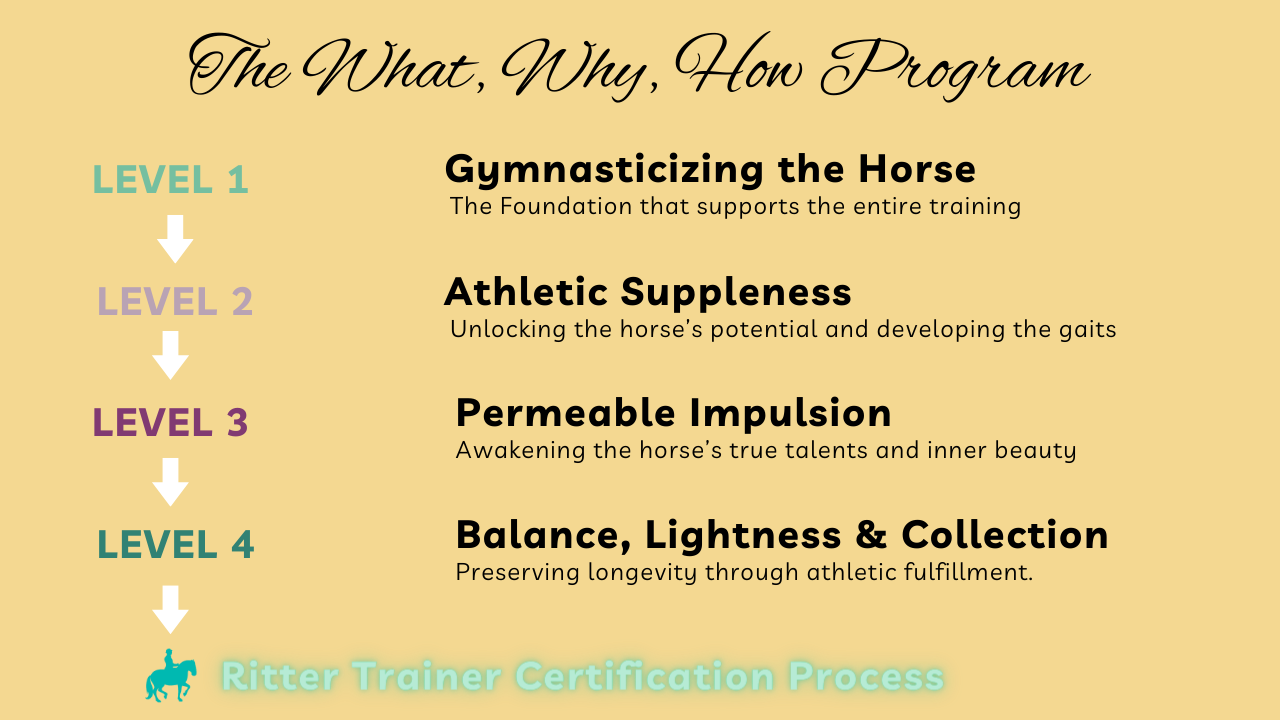
We have divided the course up into four sequential levels that takes horse and rider systematically through the training process. And the entire program leads to a Certification Process at the end! Finally, you can become a certified Ritter Trainer!
WHAT'S INCLUDED IN EACH LEVEL OF WWH
BIOMECHANICS THEORY
Biomechanically-based theory components which explain how the interplay between the horse's body and the dressage training are spread throughout the entirety of the program. The theory is designed to stimulate your mind and cultivate your understanding. Each theory lesson builds upon the previous module, but they can also be used as a reference library, to refer back to at any time.
GYMNASTIC EXERCISES
Each module has a selection of biomechanically-based gymnastic horse exercises which correspond to the theory instruction, so you are are able to immediately apply the theoretical lessons into your riding, and experience first-hand how they work. Each exercise comes with a PDF and video with complete instructions outlining what to do, why to do it, and how to do it.
INSTRUCTIONAL VIDEOS
Each horse riding exercise and every theory component is accompanied by an instructional video in which we expand upon the material further, showing you where the problem spots are in the exercise and how to address the various problems that can come up while riding it. We also explain how to modify the exercise if you need to make simpler for a less trained horse, or more challenging for a higher level horse.
DEMONSTRATION VIDEOS
Demonstration of exercises and concepts by Thomas and our team of qualified assistant trainers, with our commentary explaining what is happening and why. This is one of the most important parts of the course because we know so many riders learn best by SEEING the exercise being ridden, and also because there is no better way to understand the gymnastic influence on the horse than to see it in action. You can learn through watching what to do, what not to do, and how to correct the mistakes that commonly occur.
FELDENKRAIS LESSONS
The rider's seat is a SUPER IMPORTANT part of riding and training, and Feldenkrais works like magic for the Rider's Seat! Regardless of your age or experience level, Feldenkrais has the amazing ability to meet you exactly where you are now and help you achieve the next step in your development. Each module of the course includes Feldenkrais lessons which help you, as the rider, to learn better body awareness, coordination, flexibility, and control. Taught by Feldenkrais Practitioners, Catherine McCrum and Charlotte Zetterberg, you are in for a treat.
AN AWESOME COMMUNITY
One of the most thrilling parts of this course is the incredible community. You will join the amazing WWH Alumni Community! Since its original inception in January 2017, the community that is built around this course is the most tight-knit, supportive, and stimulating group we have ever cultivated. As a member of the course, you are granted a lifetime VISA into the community. It spans many continents, several languages, includes riders of all levels and types, and is your new homeland. Welcome home! (Lifetime Access)
Q&A COACHING SESSIONS
Being able to ask questions is an important aspect of the learning process. You have questions and we actually encourage that!!! You can ask your questions at any time in the Facebook Group but there is just nothing like getting your questions answered live. You will get access to all of the upcoming Q&A sessions for the duration of this course (two sessions each month). For a super small upgrade fee, you can always add access to future Q&As as well.
RESOURCES LIBRARY
It’s a bonus but it is worth mentioning here because the value is exponential and worth mentioning. You will get access to an extensive library of Q&As from our past What, Why, How (WWH) courses. You will also get the recordings for a huge library of other trainings we have done on a long list of topics. Never run out of fun trainings to binge-watch!
THE WWH PODCAST
Life is busy enough! You need an easy, quick way to integrate your learning into your daily life and we have the solution for you! You will get access to an exclusive WWH members-only podcast where you can listen to every video in the WWH course (for all levels you purchase) including the 2024 Q&A recordings. Turn your car drive, walk, or even washing dishes into your learning time! With a few simple clicks, you can download the Podcast feed to listen anytime, even while offline (long commutes and plane trips just got a whole lot better!).
THE WWH STUDY GROUPS
Join a study pod! Accountability accelerates performance.
LIVE HOT SEAT SESSIONS
You need precision feedback and we know that. In a Hot Seat Session, we get together on a live Group Zoom session and watch your submitted videos, and we break down what is happening, often frame by frame to point it out clearly so you can SEE and UNDERSTAND what is happening. Then we give you exercises and tips to address what we see. You can ask questions right there, and there is a chat where you can talk to the other participants in real-time. You can even ask questions about other participants' videos. If you cannot attend live, you can watch the recording afterwards (with timestamps so you can find your spot quickly). *Hot Seats are included in the complete package, and are available for an optional add-on for individual levels.
ASSESSMENTS PROCESS
*Completely optional. At the end of each level, you are invited to submit a self-assessment designed to help you, with our guidance, learn how to evaluate your progress and what you need to focus on next. Each level's assessment helps you assimilate all that you and your horse have learned, and give you the opportunity to share with us that progress and how your understanding of training principles, methodology, and trouble-shooting have developed. We will give you feedback, praise where earned, and identify any missing elements that need better attention for your future training. For those who want additional feedback and evaluation, this is perfect. It is highly recommended for those who wish to proceed into the Trainer Certification program which follows this program.
LIFETIME ACCESS
You never lose access to your course materials. It doesn’t expire or run out after a certain amount of time. That means that you can work as fast or as slow through the materials as you wish. That means that if you get sick, tired, injured - you can pause at anytime and come back to it whenever you and your horse are ready for more. It will always be there for you, and so will we. For a small fee, you can even register for Q&As and Hot Seats in future years so ongoing, lifetime support (as long as you need it) is completely doable.
What’s Inside The What, Why, How Online Course Package...
LIFELONG ACCESS to the What Why How Course
The complete updated (2024) version of the What Why How course with all of the Frameworks, Diagrams, Methods, and Exercises. Lifetime access to all of the materials. Videos, audio files, PDFs. AND AUTOMATIC UPGRADE TO ALL FUTURE VERSIONS OF THE COURSE (valid for all the levels you purchase)!
Feldenkrais Lessons for the Rider (value €250)
In depth and abbreviated lessons by Feldenkrais Practitioner, Catherine McCrum, to help you with your seat, awareness, balance, coordination, proprioception, and mobility.
Hot Seat Coaching and Feedback throughout the entire course and beyond (value €2500)
Get feedback on YOUR riding! We have two ways within this course in which you can get customized feedback. In our twice monthly Live Hot Seat Coaching Sessions, Thomas will review the submitted videos, break them down frame by frame, and you can ask questions right there. Don't want to wait for the Hot Seat session for feedback? You can also submit your video anytime in the Facebook Group and you will get feedback from Thomas and our assistant teachers.
What Why How Q&A Group Coaching Package throughout the entire course and beyond (value €2500)
Your questions answered all the way through the entire program and beyond! Not only do you get access to attend live, you also receive the recordings for every Q&A in both video and audio form so you can watch or listen to the recordings at any time. Doesn’t just include the 2024 course, but every future version of the WWH course, too!
What Why How Exclusive Facebook Group (value €150)
Lifetime access to the amazing community of our What, Why, How members. This amazing community has been growing since the inception of our original WWH Beta course. This is the die-hard, live-eat-sleep-and-breath community of like-minded riders you have been searching for.
WWH Study Pods (value priceless)
The Accountability Pods (a.k.a. Study Pods) help you increase your chances of success in this course by 95%!!!! Committing to this course and your goal with your accountability pod ensures you make this a priority. One of the reasons we have put you into small groups (a.k.a. pods) is so that there will be a variety of people with a variety of skills in each pod. NEWLY REBUILT SYSTEM FOR 2024!!!
What Why How 2024 Course Completion Certificate (value priceless)
When you complete each level of the What, Why, How course, this is something to celebrate and deserves recognition. When you finish the Assessment process at the end of the course, you will receive a personalized Completion Certificate, signed by Thomas and Shana.
Enrollment Includes these Bonuses:
BRAND NEW! BONUS: Dressage Principles Masterclass Series (value €150)
A series of fascinating trainings with Thomas and Shana Ritter on the twelve guiding principles that need to underlie the gymnastic training of your horse: The Alphabet Principle, The Root Principle, The Water Principle, The Principle of the Economy of Motion, The Aikido Principle, The Pottery Principle, The Medicine Principle, The Basketball Principle, The Ping-pong Principle, The Corner Principle, The Principle of the Narrow Track, The Pendulum Principle. Some of these are featured in Thomas’ book, “Dressage Principles based on Biomechanics” but until now none have been featured in any of our online courses. Comes with an engaging private Facebook Group and monthly activities to explore and integrate these principles into your daily training and methodology.
BONUS: 3-hour Masterclass on How to Target the Horse’s Body Areas with specific gymnastic exercises (value €150)
A very special 3-hour Masterclass Training. We go in deeper on the way the body parts are connected to the gymnastic exercises, how you can target specific body parts with specific exercises, and how to choose the right exercise for addressing a specific problem in an area of the horse’s body. There are 3 accompanying PDFs to go with this Masterclass: Exercises and Muscle Groups, Kinetic chains and blockages, and Connections between parts of the Body and Exercises.
BONUS: The Classical Lessons for the Modern Rider Series Course (value €150)
If you LOVE history and the Old Masters, you will LOVE this!!! 2 Exercises and one bonus training on each: Spanish Riding School, William Cavendish, Duke of Newcastle, Antoine de Pluvinel, François Robichon de la Guérinière, Manoel Carlos d'Andrade, Ernst Friedrich Seidler, Louis Seeger, François Baucher, Friedrich von Krane, Gustav Steinbrecht, Faverot de Kerbrech, and Nuno Oliveira.
BONUS: Rider Development Series Course (value €150)
Recordings of a series of trainings with Catherine McCrum, Shana Ritter, and Thomas Ritter on a selection of topics about the continual development of the rider. Example topics: Different learning styles: Are you visual, analytical, or kinesthetic; Rider Imagery: 3 images to help your riding; Planes (and Trains and Automobiles); Time, rhythm, and motion; Time Travel for Riders: Fast forward to the rider you will become; Exploring (and losing) the” Ideal”; Riding Down the Bones: Bones move bones - How to use this in your riding; Mindfulness and Riding, and UNruling the rules: Ditching the rules when they don’t work for you or your horse.
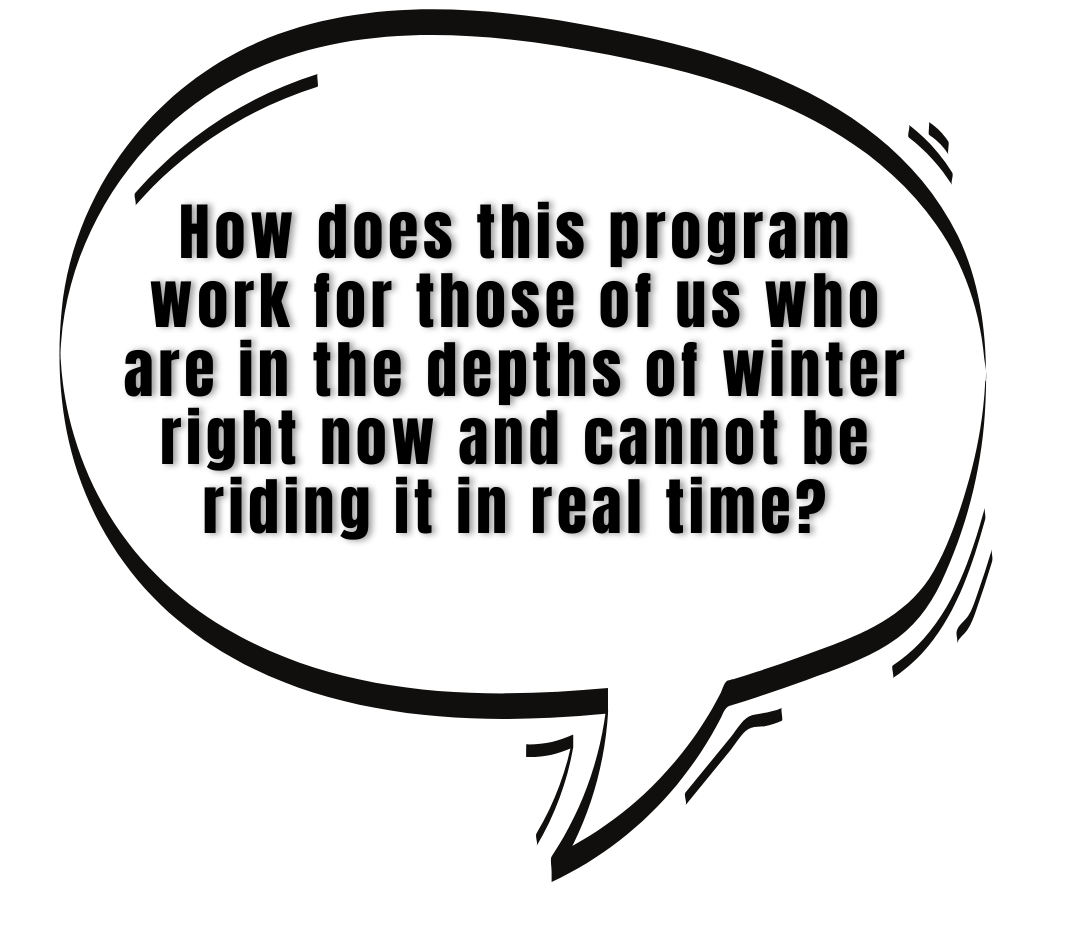
When you are not able to ride because of weather (or it could be that injury or illness happens, too), you can pick it up exactly where you left off AND you can spend as much time as YOU need on each module before moving on to the next. The program is designed so that even though the modules are released on a certain schedule, you can go through the content on a schedule that suits you and your horse. We designed it this way on purpose, because horses and riders are individuals and you cannot put everyone on exactly the same pace in the training.
The LIVE elements are designed to support you wherever you are - so there will be those attending the Q&As or Hot Seats who are sticking with module 1’s contents and polishing them alongside others who are on module 4 or 5 and others who have been through the program before and are repeating it. You can submit your videos for wherever you are for feedback and help on whatever you are working on. You will have lifetime access to all the materials including all future additions and upgrades to the course. You also have lifetime access to all the Q&As and Hot Seat sessions for future rounds of the course.
During times of bad weather, we would recommend taking that time when you naturally want to be indoors to really dive into the materials, watch the trainings, go through the ample bonus materials and really invest in your learning so that later, when the weather turns nicer and you want to be outdoors more, you already have this theoretical training under your belt.
Brand New! The What, Why, How 4-Level System
WWH Level 1
The Purpose of Dressage Movements
The Training Wheel
The Quality of the Gaits
Rhythm, Tempo, & Speed
Introduction to Longeing
How to Warm-up
Stretching Forward-Downward
Introduction to Work-in-Hand
Going Forward
Up Transitions
The Rider's Seat & Aids
Turning the Horse's Shoulders
Stopping and Half-Halts
Bending
Side-Stepping
1st Test of the Inside Hind
Voltes & Circles
Turn on the Forehand in Motion
Leg Yield
Corners
Accuracy & Alignment
Serpentines & Curved Lines
Introduction to Stirrup-Stepping
Throughness
Rider Position
How to use the Seat & Aids
Rising & Sitting Trot
Peer Review Assessments Process
Starts January 22, 2024
WWH Level 2
The Spiral Nature of Learning
On the Bit, Aids, and Seat
The Flexible Ribcage
Improving Transitions
Straightness
The Shoulder-Fore
2nd & 3rd Test of the Inside Hind
Energizing the Horse
The Full Pass
Slowing Down
Cadence
Plié
Counter Canter
Triangles
Shoulder-in
Simple Changes through the Walk
1st , 2nd, 3rd Tests Outside Hind
Lengthening the Stride
Increasing the Jump & Quality of the Canter
Timing and Coordination of the Aids
Combining the Tests of the Hind Legs
Haunches-in
Effective Training
Strategy for Modifying Exercises
Suppleness
Groundwork and Work-in-Hand
Acceptance of the Aids
Improving Relaxation & Contact
Level 2 Peer Review Assessment Process
Starts After Level One
WWH Level 3
The Training Wheel
Turn on the Haunches
Passade
Improving the Canter Further
Imagery & Visualization Tools
The 8 Different Types of Exercises
Core Strength
Improving Straightness
Targeting Specific Body Parts with Exercises
Preparation for Flying Changes
Correcting Crookedness
Improving the Square Halt
Milling
Introduction to Double Longeing
Reinback
Lateral Movements with Stirrup Stepping
Impulsion & Schwung
Beginning the Half Pass
Working with the Renvers
Medium & Extended Gaits
Framing the Horse with the Aids
Authentic Permeability
Trouble-Shooting
Growth Mindset
Improving the Seat
Developing & Improving the Half Pass
Level 3 Peer Review Assessment Process
Starts After Level 2
WWH Level 4
Artistry as a Rider
Lateral Balance
Longitudinal Balance
Collection
Lightness of the Forehand
Pushing vs. Carrying Forces
The Soundness-Balance Connection
Lateral Nimbleness
Topline Muscle Development
Healthy Back Movement
Advanced Biomechanics
Developing Flying Changes
Pirouette Renversee
Soundness and Lameness
Artistry in Gymnasticization
Advanced Renvers
The Double Bridle
Zig Zag Half Passes
Crafting the Pirouettes
Piaffe Training
Riding with Fine Aids
Reinback in Lateral Movements
Advancing Further
Polishing the Cadence
Passage
Tempo Changes
Mindful Riding
Developing Expertise
Level 4 Peer Review Assessment Process
Leads to Certification Process
Starts After Level 3
THE COURSE OFFICALLY BEGINS ON January 2024.
The course starts on January 2024, and then the course closes until we re-open in Fall 2024. Regardless of when you enroll, you get to take every future version of the course (for all levels purchased), so the question is really.... How long do you want to deny yourself the opportunity to embrace the What, Why, and How of training your horse?
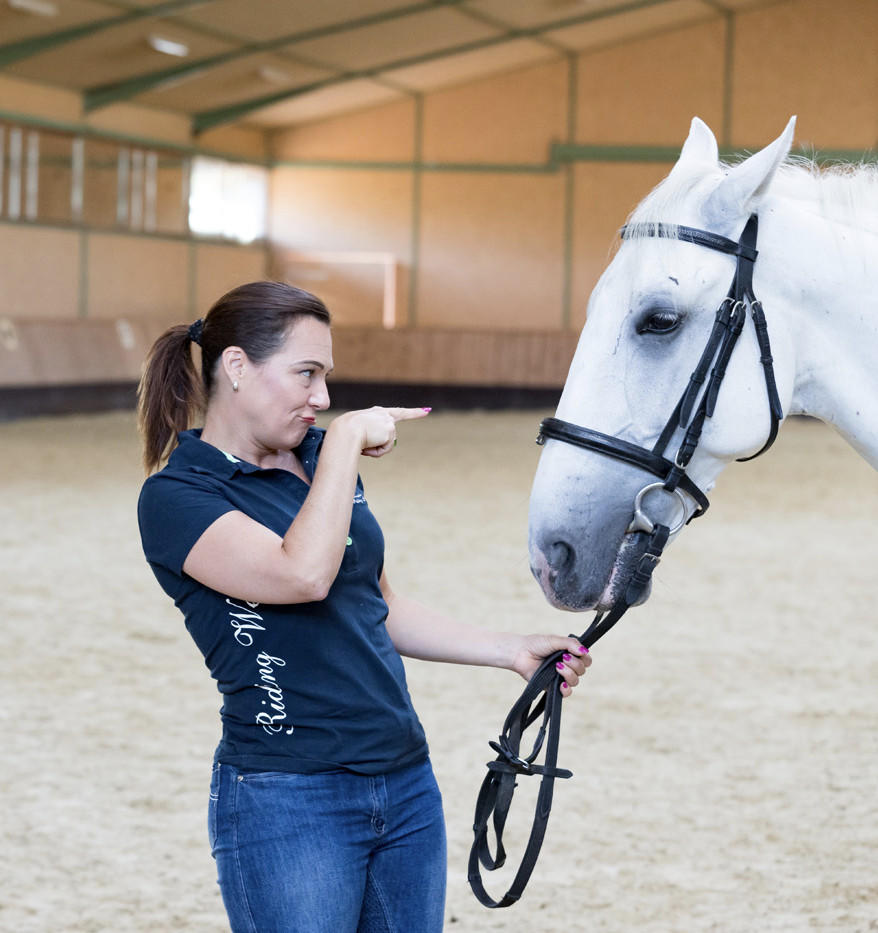
Take a look at what we'll cover in WWH Level One
In this "Introduction to What, Why, How" mini-course, we’re going to teach you the earliest lines and simplest patterns that all horses need to begin. Most people skip over this foundational step and want to skip ahead to the fancy stuff, but we promise you, the training goes so much smoother when you build it on a solid foundation of understanding before you progress to the fancier stuff.
In WWH Intro we’ll cover:
- Geometry of the Arena
- The Landmarks you need to know to orient your patterns
- The Basic Lines that all horses begin with in their training
- Where are my Horses's Feet?
- Introduction to Feldenkrais including 4 Fundamental Feldenkrais Lessons
- Counting Strides
- Changing Rein Part 1 (centerline, halfschool line, long & short diagonals)
- Changing Rein Part 2 (reversing out of the corner, reversing into the corner, changing out of the circle, changing through the circle)
- Exercises Worksheet
- Progress Tracker Worksheet
In Module One of Level One, we’re going to start at the foundation: Your WHY.
In Module 1 we’ll cover:
- The Purpose of Dressage Training
- The Purpose of Dressage Movements
- The Training Wheel Overview and Application for Level One
- Brief Overview of the 6 Demands for Level One
- Rhythm & Tempo
- Alignment and Arena Patterns
- Why do Circles need to be ROUND
- The Three Rider Toolboxes: The Rider's Seat & Aids, The Movements, and The Exercises
- How to Ask the Right Questions
- All About Circles
- How to use and ride exercises
In Module Two, we're going to dive immediately into why and how to longe your horse in a way that will prepare your horse best for and also complement the ridden work.
In Module 2 we’ll cover:
- Why Longeing?
- How to Longe with a Cavesson
- Introducing the Longeing
- Longeing and Half Halting
- Transitions on the Longe Line
In Module Three, we’re going to pull back the curtain on how to structure your horse’s training and how to warm up your horse optimally.
In Module 3 we’ll cover:
- Relaxation
- The Importance of Warm-up
- The Objectives of Warm-up
- Different Kinds of Warm-up
- Warm up with Turning and Bending
- How to Structure the Horse’s Training
- Cultivating a Beginner’s Mindset in Riding
- Getting into the Right Frame of Mind
In Module Four, we’re going to teach you how to look at everything we ride in Dressage in terms of the 6 Essential Demands a.k.a. our Dressage Biomechanics Framework. Learning to see every movement, every exercise, every element of every ride in these terms sheds a whole new light on the training which gives you greater perspective and clarity. Rather than complicate the training, it simplifies how you see everything. Then we will dive into Element #1 which is all about going Forward.
In Module 4 we’ll cover:
- Introduction to the Dressage Biomechanics Framework
- Dressage Biomechanics Framework Overvie
- Introduction to Forward
- Forward - What & Why
- Common Mistakes And Misconceptions In “Going Forward”
- Habit of "Balking"
- Transitions
- Forward Aids
- Lower Leg Aids
- Lower Leg - Walk, Trot
- Driving Seat Aids
The Rider's Seat and Aids are so important! In Module Five you get to take a luxurious deep-dive into exploring how to sit (and why to sit that way), how to use the seat, how to give your aids, and how to help the horse with your seat.
In Module 5 we’ll cover:
- Developing the Seat
- Form and Function of the Rider’s Seat
- Rider Seat Position
- The Rider’s Torso and Shoulders
- Stirrup Length
- The Rider’s Pelvis
- The Rider’s Thighs
- The Rider’s Knees and Lower Legs
- The Rider’s Arms, Elbows, Wrists, and Fingers
- Fixed Hand vs. Following Hand
- Ways of Holding the Reins
- Ways of Holding the Whip
- Rising Trot
- Sitting Trot
- Overview of timing of the aids
- Balance and Support
- Spreading Yourself Out (Support)
- The Knees
- Letting gravity pull you deeper into the saddle
In Module Six, we continue with the theme of the six essentials by exploring how to turn the horse's shoulders. All curved lines and turns involve turning of the horse's shoulders. Why is this essential and how do you do it in a way that is biomechanically correct and beneficial to your horse?
In Module 6 we’ll cover:
- Introduction to Turning Shoulders
- Turning Shoulders (The What)
- Turning Shoulders (The Why)
- A Good Turn has to Meet Certain Quality Criteria
- How Can I Meet these Quality Criteria with My Horse?
- Turning Shoulders - Seat and Aids
- Turning Shoulders - Common Mistakes
In Module Seven we explore another "essential" which is stopping and half-halting.
In Module 7 we’ll cover:
- What is The Half-Halt?
- How to give a Half-Halt
- Timing of the Aids and the Half-Halt
- Introduction to Stopping
- The Stop (The What)
- The Stop (The Why)
- The Stop - Weight Aids
- The Stop - Rein Aids
- Common Mistakes in "Stopping"
- How To Fix The Rushy Horse
In Module Eight, we explore another essential which is Bending.
In Module 8 we’ll cover:
- Bending Masterclass
- Introduction to Bending
- Bending (The What)
- Bending (The Why)
- The 3 Phases of Bending
- Ingredients of Bending - Intro
- Bending in Motion - The Three Phases of Bending
- The First Phase of Bending in Motion- single track
- No Bend without Stretching
- No Bend without Correct Alignment
- No Bend without Flexion of the Haunches
- No Bend without Mobile Rib Cage
- No Bend without Balance
- No Lateral Movement without Bending
- Bending Seat and Aids - How do you Create a Good Bend?
- Bending - Common Mistakes
- Bending Checklist
- Circle Line vs. Corner Line
In Module Nine, get into the nitty gritty of Voltes and using voltes as an integral part of your horse's development. We will explain WHY this is so important and how it is one of your most helpful tools.
In Module 9 we’ll cover:
- All About Voltes
- Counting Strides on a Volte
- Exploring Voltes In The Tradition Of The Spanish Riding School
- The Changing Rider by Charlotte Zetterberg
In Module Ten, you will explore the concept of Contact and HOW to establish a correct contact.
In Module 10 we’ll cover:
- Why do I need rein contact?
- Connection and Rein Contact as a Whole Body Experience
- Honest Connection vs. Fake Outline
- Road Map to a Good Rein Contact
- What does “on the bit” mean?
- What is the right amount of contact?
- How much is too much contact?
- What is the right rein length?
- In Module Eleven, you get to explore an extremely useful tool that you can use to support all of your under saddle training: work-in-hand.
In Module 11 we’ll cover:
- What is Work-in-Hand
- Why do Work-in-Hand?
- How to hold your hands and the whip
- Using the Whip
- How to walk along side the horse
- Body Position
- Your Balance and how to carry yourself
In Module Twelve, it's time to work on the canter. You will get a solid foundation on how to evaluate the quality of your horse's canter as well as how to help set your horse up for the best possible canter.
In Module 12 we’ll cover:
- Prerequisites of the Canter
- Canter Departs
- When to canter & When NOT to canter
- When to canter (with a young horse)
- The characteristics of a good and bad canter
- Shaping the Canter with the Seat and Aids
- Lower Leg Aids - Canter
- How to regulate the speed and tempo of the canter
In Module 13 you get to explore the fascinating world of Stirrup Stepping. Stirrup Stepping is a fine, subtle weight aid that is inherently intuitive for the horse. Whether you have used stirrup stepping before or you are new to this technique, you will find so much to explore in this module!
In Module 13 we’ll cover:
- Stirrup Stepping - Why? - Stirrup Stepping - What is it?
- Stirrup Stepping into the Outside Front Leg
- Stirrup Stepping into the Inside Front Leg
- Stirrup Stepping into the Outside Hind Leg
- Stirrup Stepping into the Inside Hind Leg
- Stirrup Stepping into the Diagonal Pair
- Stirrup Steppling Important Notes
- Stirrup Stepping Practical Application
- Stirrup Stepping: The Walk and Trot
- Stirrup Stepping: The Walk Continued
- Stirrup-Stepping Legend
- Timing and Footfalls of Stirrup Stepping
- Stepping Not Stomping
- How - A-B-C-D Stepping
- Sequences of stirrup pressures
In Module Fourteen, we will focus on the quality of the gaits. That means both the quality of the horse's movement as well as the quality of the conversation we are having with our horse through the training.
In Module 14 we’ll cover:
- Quality over Quantity
- Better Quality through Observing the Pause
- How to improve the Quality of the Walk
- What is Good Movement
- A Framework of Observation with Catherine McCrum
In Module Fifteen, we explore another of the "essential" biomechanic movement patterns: side-stepping both in theory and in practical application. This brings us to explore our first of the 6 Tests of the Hind legs, which is a framework we learned from our teachers at the Spanish Riding School.
In Module 15 we’ll cover:
- The 2nd Phase of Bending in Motion- Bending with sidestepping (
- Sidestepping and bending against the direction of travel
- Don’t Give It A Name Yet - Defining Priorities In Training
- Introduction to Sidestepping
- Sidestepping (The What)
- Sidestepping (The Why)
- Sidestepping, Bending, & Alignment
- Sidestepping - Common Mistakes
- Sidestepping - Seat & Aids
- The 6 Tests of the Hindlegs (SRS) overview
- 1st Test of the Inside Hindleg - ENLARGE
In Module Sixteen, we will explore the often misunderstood and under-utilized Turn on the Forehand in Motion (TOFIM) as was passed down to us from our teachers in the Spanish Riding School Tradition. It is also a practically-based movement in Working Equitation, and you will find it supremely useful for beginning to supple your horse's hips.
In Module 16 we’ll cover:
- Introduction to TOFIM
- Strategy approach - Imprecise to gradually increasing levels of precision
- Lateral suppleness of the hips lead to longitudinal suppleness of the hips
- You have to fall in love with the process
In Module Seventeen, you get to investigate the classical use of the leg yield in the training of your horse.
In Module 17 we’ll cover:
- The "Classical" use of the Leg Yield
- Understanding the Leg Yield
- The Weight and Seat in the Leg Yield
- Common Rider Errors In Leg Yield
- Leg Yield - Part 1
- Leg Yield - Part 2
- How to begin training the leg yield in walk and trot
One of the most under-utilized spot of the arena is the corner. In Module Eighteen, you will learn how invaluable corners are for your training strategy and you will learn how to ride smooth, graceful, well-balanced corrners.
In Module 18 we’ll cover:
- Improving the Corner
- Mental & Physical Flexibility
- What to do when the horse leans in one direction?
- About Riding Corners
- How to Ride a Corner
- Stirrup Stepping: The Canter
- Center Line Turn Correction
- Stop into OH before Turn to Improve Turns
- In Module Nineteen, we return to the theme of Contact in a new context. You will see that revisiting concepts again and again gives you the ability to build upon your knowledge in deeper ways.
In Module 19 we’ll cover:
- Feeling the Footfalls & Timing of the Aids
- How do I pick up the reins or shorten the reins?
- How do I get the horse to reach forward to the rein contact?
- Part 1 : Through the Back - what does it mean?
- Part 2 - Through the Back - what does it look like?
- Why is “throughness” important
- Forward-downward stretching: What, Why, and How
At this point, we do our first Peer Review Assessment Process. At the end of each level, and when you are ready (you can take the course as many times as you like until you feel ready), you are invited to participate in our amazing peer-review assessments process. An incredibly warm and enriching experience, you are guided through how to evaluate your own progress as well as each others' progress. Completion of the peer-review assessment process unlocks the ability to begin the next level.

"No question. I would recommend this course.”
“I was very suspect of an online course. I mean, I did have access to SuperDuper trainers and clinics in Europe. And so, and where I am here in Canada, there are super trainers here too, but they're just not close to me. So I was really not thinking I would get much out of the online course. But, in fact, I just found it to be very fulfilling and the progress and the improvement in my horse, he was looking a bit old and that's normal at 21. But these days I find that he looks great. The horse chiropractor came the other day and she said to me, ‘oh my God, he's the new 12, not 22!’ And so it's really a return on investment because the horse just made leaps and bounds in progress. But so did I, and that was really, really, really great. No question. I would recommend this course.”
- Kimberly Dawne Allen, Canada
"It’s been quite a life changing experience.”
“I would highly recommend the, What Why How course to absolutely anybody who would like to learn and becomemore proficient in training their own horse, or even training other people's horses or even just for, for fun. Really. You can do anything with it. You build confidence within your yourself as well. In every way you can, you can improve yourself and your horse, no matter what level, where you are, even in your life. I've never ever come across anybody that's ever given me the details and the support that the Ritters have. It’s been quite a life changing experience. And I would highly recommend it. Absolutely. One hundred percent.“
- Sharon Gallagher, USA
"I think the lifetime access is one of the biggest arguments as to why to take the course.”
“What struck me as different from the beginning with Ritter Dressage was the direct conversations in real time that Thomas has with the students. And so, when one has a question to ask whether one asks it on the Facebook page or in one of the Q&As, you actually get an answer back in person. You genuinely can have a back and forth conversation. And, I don't think many other online courses offer that.“
- Jacky Davies, UK
"This is the course that I would recommend beginning with. It's so complete. There's nothing lacking. ”
“I've really grown in my knowledge. I've learned more in this course, in the first couple months than I've had in the last 40 years. I am here pretty much alone because there aren't people around me that have horses that ride regularly. So I was starting to almost lose interest. I really was wondering how long I could keep riding. And now I see myself riding well into my late seventies, without a problem, I've lost weight. I keep fit because now I see how important that is for my riding. And it's really changed my whole life. And having the community support! I have friends all over the world now. And so it's really been a huge augmentation to my life. I already had a great life, but now it's even so much better! I just I'm really thankful for the course that started me off on this.“
- Carla Powell, USA
"You don't feel daunted, you don't feel judged. You don't feel over faced. You don't feel challenged beyond what you are capable of doing.”
“You'll have a paradigm shift in your understanding particularly if, like me, you only had a functioning, fundamental understanding of dressage and only dressage as sport, not classical dressage as a training strategy for building a better horse, a stronger, fitter, healthier horse, and doing the same for you as a rider. Everything you learn makes you a better rider - makes you a more reflective rider, makes you think about things, makes you stop and take note, helps you build a connection, gives you the tools to talk to your horse and gives you the tools and the mental headspace to listen to what the horse has to say back.“
- Naomi Betts, Australia
"I'm really pleased I made the decision to invest in the What Why How course. ”
“The course has given me so much more confidence. It's improved my relationship with my horse a lot. The course came at the right time for me. I was struggling quite a bit. I wasn't really sure what direction to go in with my horse. And this just gave me so much more confidence to have a plan in my riding. And it gave me some structure to my rides, which gave us some purpose and it's really, really helped us develop over the course of 18 months. I've made some friends through the group as well. People that I'm in contact with outside of the course. And these are people from all around the world that I probably wouldn't have chance to meet. And now I've got the network of like-minded people from lots of different countries, which has been abenefit I didn't expect to achievement online course."
- Katharine Trevelyan , UK
Two Enrollment Options for 2024
WWH Level 1 begins on January 22, 2024
The Complete 4-Level
What, Why, How Training Program

The entire What Why How Training Program: Levels 1-4
(lifetime access, repeat the levels as many times as you like)
Introduction to WWH Mini-Course
What Why How Exclusive Facebook Group (lifetime access)
What Why How Q&A Group Coaching Package and Q&A archives
(lifetime and ongoing access to all the Q&As for each level)
Live Hot Seat Coaching Sessions
(lifetime and ongoing access to all the Q&As for each level)
What Why How Accountability Study Pods for each level
(optional participation)
Participation in Final Assessment Peer Review Process for each level
(repeat it as many times as you like
What Why How Completion Certificate for each Level
Eligibility to participate in the Ritter Trainer Certification Process at the completion of all 4 Levels
...and all the additional bonuses listed below in the Bonus Section
Complete Program Registration - €3897**
** available in other currencies. Payment Plans Available.
(get started for as low as €338/month!)
What, Why, How Level 1 Only
Level 1 of the What Why How Training Program
(lifetime access, repeat as many times as you like)
Introduction to WWH Mini-Course
What Why How Exclusive Facebook Group (lifetime access)
What Why How Q&A Group Coaching Package and Q&A archives
(access to all the Q&As for Level 1 only)
Live Hot Seat Coaching Sessions
(access to all the Hot Seats for Level 1 only)
What Why How Accountability Study Pods for Level 1
(optional participation)
Participation in Final Assessment Peer Review Process for Level 1
(repeat it as many times as you like
What Why How Completion Certificate for Level 1
Eligibility to register for Level 2 at the completion of Level 1
...and all the additional bonuses listed below in the Bonus Section
Complete Program Registration - €1297**
** available in other currencies. Payment Plans Available.
(get started for as low as €150/month!)
Our What, Why, How Guarantee!

We promise that you CAN do this.
But the best part is… you don’t even have to believe us.
If you’re not 100% satisfied with the What, Why, How course program, the training exercises and strategies, or our extensive support after 30 days, we will offer you a full refund, rider’s honor!
That means you can enroll today, and you don’t even have to decide if you’re in for good! Take the full 30 days to explore the materials, bonuses, and the life-changing experience of the What Why How family and Ritter Riders culture, and make your decision then. That enables you to make the decision then based on the experience you have first-hand in the course materials, rather than making the decision based on what you don’t yet know.
Refund Criteria: We want you to make a fully informed decision before you request a refund. Therefore, before we grant you a refund, you must show that you have completed the course content up to that point and have attended at least one Q&A or Hot Seat session.
Where you have purchased the course as an ‘early bird’ the 30 day period will be extended to include a period of 30 days from the start of the course (January 22, 2024)
BONUS: Virtual Élève Bundle (value €200)
A collection of videos where we recorded commentary “reaction videos” about an assortment of videos from the Spanish Riding School, Nuno Oliveira, and Modern Competition Riders. This is a growing collection, and you will automatically receive all future additions.
BONUS: Mindset for Riders Package (value €200)
Recordings from our Mindset Trainings on these topics: “Slow Down - you can’t rush the process”, Procrastination, Perfectionism, Turning your Fear into an asset, Fear in Riding (with Marcella Becker), Mental and Physical Flexibility, how to positively use your mind as a riding aid, Limiting Beliefs (with Liz Bloch), When to push through and when to back off, Transcending Dogma, Feeling vs. Thinking, Expectations, Experimentation in Riding, and Using Visualization and Imagery in your riding journey.
BONUS: What, Why, How Resources Library (value €300)
Extensive library recordings of all of our live trainings on a range of topics in both English and German, including all of the recordings from all of our previous challenges. A wealth of reference material!!! Not available for separate purchase.
BONUS: Arena GPS 1.0 eBook (value €30)
In this first edition of the Arena GPS eBook series, you get a compilation of basic exercises with graphics and brief explanations. You can download this onto your phone so that you can take this with you into the arena in order to gain ideas and inspiration for training arena patterns. These patterns are all sprinkled throughout the What, Why, How course. More than 50 exercises, adaptable to any level of training.
BONUS: “The Ritter Way” Journal eBook (value €19)
With this journal, you can document your and your horses’ training progress. It includes arena diagrams for sketching the exercises you ride and ample space for recording your observations, thoughts, and discoveries. The journal is peppered throughout with quotes from Thomas’ teachings for inspiration along the way.
BONUS: The Thinking Rider Challenge Recordings (value €250)
The complete downloadable recordings (video and separate audio for listening while driving, etc.) of the November 2023 and January 2024 Thinking Rider Challenge sessions, including the two VIP Bonus sessions.
"I couldn't have asked for more. It was brilliant.”
"If you are gonna start any of the courses, start with the What Why How because it covers everything. It's not just one thing. It covers everything, everything you need to know, it's the best course. It was worth every bit of money. You can pay for an hour's lesson for 20, 30, 40 euros per week and not come out with anything. And I came out with so much more. I can't remember where I worked out at a week, but I come out with so much, it was unbelievable. I recommend this course to everybody. All levels. Even high level people could learn a lot, a lot. That speaks volume. I can't believe how much I learned.”
- Bev Slack, Ireland
"I finally feel like I'm not faking it anymore.”
“I kind of feel like I've just been like, faking it to make it. I mean, I have a USDF bronze medal that I kind of did on my own with, with trainers, but I was always kind of training the horse while I was learning myself. So I didn't really know what I was supposed to be feeling, and I didn't really know what made each movement to be done correctly. And so for me, The What Why How Course was around understanding biomechanically what the horse is supposed to be doing, what I'm supposed to be doing, and then Feldenkrais on top of it has allowed me to feel my body again. That combination of understanding the theory from a real sense, and being able to feel it in my body was pretty powerful for me.“
- Kate Murray, USA
"I've learned how to help my horse.”
“The biggest progress is I have, have learned to train my horses. I've taken other courses, but this is very different to a lot of other courses, because you start in the very beginning and working through everything where dressage starts. So you can start with an uneducated horse and you work through everything dressage. It's possible to do this for every horse, every kind of horse. I feel confident with what I am doing.“
- Katrin Malmqvist, Sweden
"This course has really made me a better horse person, a thinking horse person.”
“Without this course, I would be still struggling on a number of issues and not knowing how to solve them. The What Why How course gave me a roadmap. It gave me a way to work through problems and solve them. It made me basically a thinking rider. It was so super that through the course, I've solved issues that I couldn't solve for ages. One, for instance, my one horse was very spooky and we weren't really sure why. What it turned out to be was she was actually protecting herself because she was so athletic and yet had an injury. And by he helping her discover her own abilities through various exercises as directed through the course, I was able to give her the confidence that her spooking is completely, completely switched off. And she's now a much more rideable horse.“
- Kim Underwood, Canada
"The quality of instruction is far higher than I've ever had from a live trainer.”
“I would recommend the, what, why, how course to every single rider, you can't go wrong taking this course. You will learn whatever discipline you are following. You will learn so much and you will never ever regret the investment. The investment you make on this course is GOLD for your learning and for your experience. And you will learn more and you will see improvements in your horse than you have ever found with a live trainer. I was, uh, very, uh, surprised how effective the hot seats were. And I can highly recommend the hot seats to any prospective course members. The quality of training and the sharp eye of Thomas to analyze the ride. And it's not at all critical. It's just training your eye and training yourself to see and know what you can do to improve things for you and your horse.“
- Bella Collins, Germany
Meet one of our Assistant Trainers who started out right where you are...
When thinking about this crazy and fascinating dressage journey, I’m reminded of one of our students, Kristen Guest in Prince George, Canada. She started riding with us when we still lived in the U.S. Her first clinic with us was in Edmonton, Canada where she brought a cranky Thoroughbred she had previously been told was absolutely unsuitable for dressage.
In her words, “The results of three days of lessons were so good that I ‘followed him home,’ so to speak. I spent a month training with him and Shana in 2009.
The effects of this relationship have been profound: I began to develop as a rider, and my “unsuitable” horse demonstrated the capability for upper level work both physically and mentally.
My skinny thoroughbred developed dramatic muscling across his topline and changed his posture both under saddle and in the pasture. As he began to trust that the demands placed on him would be progressive and fair my cranky and untractable horse became happy and co-operative.
At the end of the first year of training with Thomas the same people who had said my horse was untrainable began to ask where I got this new horse.”
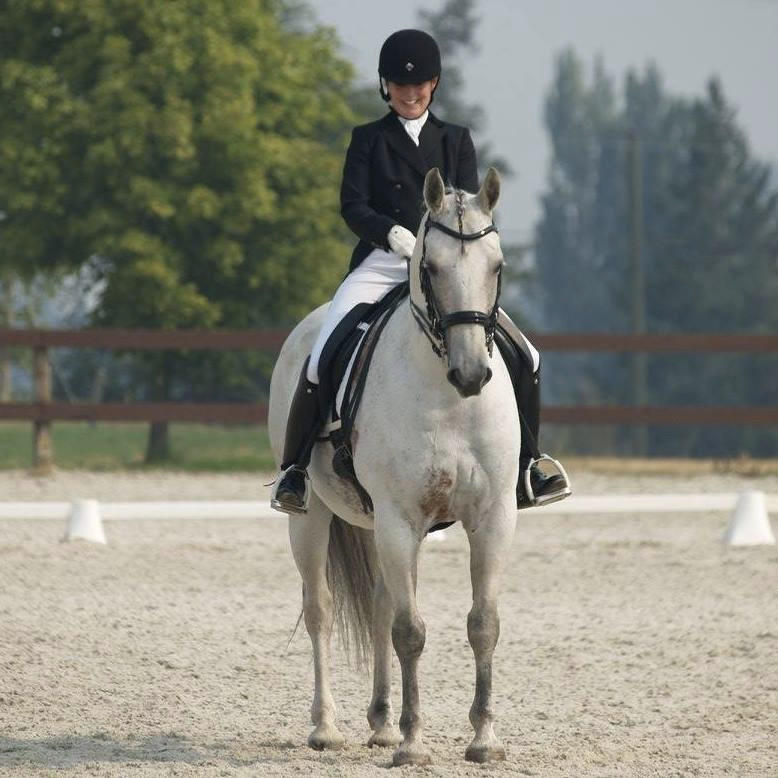
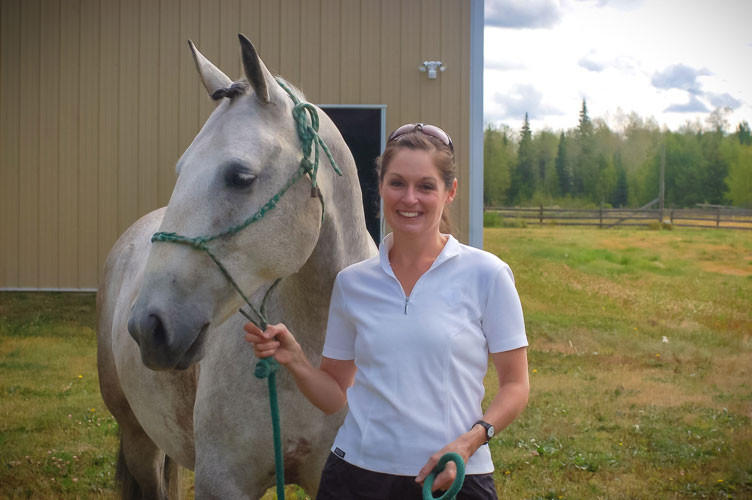
But a year later when we moved to Germany, Kristen was not so easily able to just ‘follow us home’ so we began a program of online coaching.
Since that time she began to work with her young Lipizzan, "Scorpio". Through ONLY coaching online and no other lessons or training help, she has been able to bring him along from untrained, totally green to upper level dressage work including piaffe, passage, canter pirouettes, series of flying changes.
She and Scorpio WON her classes their first time out at Prix St. George, competed successfully at Intermediere I and II, and have just made their successful debut at Grand Prix.
Kristen is now one of our Assistant Instructors in the What, Why, How course.
Watch the interview with Kristen here...
FREQUENTLY ASKED QUESTIONS
We know you have a busy life, you need time to actually go to the barn and ride your horse so you can implement what you are learning, and you don’t want to spend ALL of your time sitting in front of a computer watching videos every week. That is why we have broken this course down into weekly modules with periodic "Break" weeks to give you an opportunity to catch up, review, and implement. This way it is doable EVEN if you fall behind. Each module should take you no more than, on average, 1-2 hours per week to go through (several weeks are a little more content-heavy, however). In addition, there are two Q&A sessions per month and two Hot Seat sessions per month, and each one lasts, on average, 2 hours. Participation in those is highly recommended but optional, of course. And then, we cannot predict the amount of time you spend in the Facebook Group because that is entirely dependent upon how much time you enjoy interacting with the other riders in there.
This course is suitable for thinking riders who are passionate about learning and have been looking for someone to answer all their questions. It is suitable for you:
- Whether you are a novice or professional rider.
- Whether you are a dressage rider, a jumper, a western rider, or anything else in between.
- Whether you have taken every online course out there, or have never taken one before.
- Regardless of the breed or kind of horse you ride
- Regardless of the kind of tack you use, or whether you use no tack at all (bitless, bareback, no problem!)
- Regardless of whether you primarily ride or do work from the ground (most exercises are adaptable to work-in-hand and at the long-rein, and we are able to suggest modifications when needed)
- Whether you are ambitious or wish to take your time.
Honestly, if you start working through the Intro to WWH mini-course and the instant access bonus materials right away, you will already be seeing results before the course begins. That is how effective this system is.
We begin this course with the foundational elements precisely because we do not want to make any assumptions about what you do or do not know, and besides, nearly everyone has gaps in their education at some point. Therefore, this course is appropriate for you whether you are lower-level and/or just beginning dressage or whether you have been riding for many years. It is so adaptable and comprehensive that it is absolutely suitable for professional trainers who wish to supplement their education, and in fact we have many professionals in our course programs.
You need a horse to ride and a relatively level space to ride in. An arena with adequate footing is recommended but we have had course members who have had success even without a standard “arena” to ride in. In most cases, you can modify the exercises based on your riding conditions and we are able to suggest modifications whenever you need help finding a suitable way to modify an exercise for your situation. Not required but recommended: approximately 20 cones or other arena markers (homemade is fine), a smartphone/video camera/robotic camera to record your rides. You will also need an internet connection and a computer/tablet/smartphone with which to access the course materials and Facebook Group.
If you want feedback on the exercises ridden in the course, you can submit video. Each session has its own GoogleDoc on which you will sign up for a spot. In the Session, Thomas will be reviewing the submitted videos live on Zoom. He will break down what is happening. He often plays the video frame-by-frame to point it out clearly so you can see what he is explaining. He will give you exercises and tips to address what he sees. You can ask questions right there, and there is a chat where you can talk to the other participants in real-time. If you cannot attend live, you can watch the recording afterward. No submission is left unanswered. If there are more submissions than Thomas can finish within that session, we will schedule follow-up session(s).
There are usually two Q&A coaching sessions per month and two Hot Seat Sessions per month, and the times will vary so that we can accommodate our members all over the world in different timezones, with some additional sessions at the beginning of the course to help you get going with the course content.
If we do not complete all the submitted hot seat requests within the time, we schedule follow-up sessions and these are announced separately.
All sessions are held through a Zoom webinar. Instructions for how to download the free Zoom software and how to access the sessions are included when you enroll and also enclosed in each event reminder.
It is very easy to subscribe to the Course Calendar which automatically converts all the times into your timezone. You can even set reminders through your Calendar so you never miss a session!
Not a problem. All sessions are always recorded and the recordings are uploaded to the Q&A archives within 24-48 hours after the session is over. Every recording is available in downloadable video and audio format so you can watch or listen, whenever, and wherever you prefer. They are also added to the Podcast for offline listening!
The complete course is broken up into 4 Levels. Level 2 will follow Level 1. Level 3 will follow Level 2 and so on. At the end of each level, there is a Peer Review Assessment Process. Completion of that process unlocks your Level Completion Certificate and eligibility to enter the next level.
At the end of all four levels, you will be eligible for the Trainer Certification Process which is still under development,
There are break weeks integrated throughout the course for catch-up and review.
Here is the tentative content release schedule for Level One (subject to adjustment):
LEVEL ONE
Starts January 22 with Orientation
Module 1 - January 26, 2024
Module 2 - February 2, 2024
CATCH-UP/ASSIMILATION BREAK - February 9-15
Module 3 - February 16, 2024
Module 4 - February 23, 2024
CATCH-UP/ASSIMILATION BREAK - March 1-7, 2024
Module 5 - March 8, 2024
Module 6 - March 15, 2024
CATCH-UP/ASSIMILATION BREAK - March 22-28, 2024
Module 7 - March 29, 2024
Module 8 - April 5, 2024
CATCH-UP/ASSIMILATION BREAK - April 12-18, 2024
Module 9 - April 19, 2024
Module 10 - April 26, 2024
CATCH-UP/ASSIMILATION BREAK - May 3-9, 2024
Module 11 - May 10, 2024
Module 12 - May 17, 2024
CATCH-UP/ASSIMILATION BREAK - May 24-30, 2024
Module 13 - May 31, 2024
Module 14 - June 7, 2024
CATCH-UP/ASSIMILATION BREAK - June 14-20, 2024
Module 15 - June 21, 2024
Module 16 - June 28, 2024
CATCH-UP/ASSIMILATION BREAK - July 5-11, 2024
Module 17 - July 12, 2024
Module 18 - July 19, 2024
CATCH-UP/ASSIMILATION BREAK - July 26-August 1, 2024
Module 19 - August 2, 2024
Module 20 (Peer Review Process) - August 9, 2024 - October 5,2024
Just because the modules are released on this schedule does not mean you need to complete the content at that pace. You can take as much time as you need to go through each module. You have lifetime access to the materials, all course upgrades, and the Facebook Group, so you can work through it all at the pace that best suits you and your horse. You can come back to it at any time, you can start over at any time, and you can pick up wherever you left off whenever you like.
Every single video, audio file, every exercise PDF, diagram, checklist… EVERYTHING is completely downloadable and yours to keep forever. You can also download the podcast to listen offline.
This course is yours to learn from however it suits you best. Some of our other members are instructors who no longer ride anymore but they use our trainings and exercises to improve their teaching for their students. We have had members join when they are unable to ride due to injury, illness, pregnancy, or life circumstance. It is not a problem. You can study the materials and apply the riding exercises later, etc.
When you enroll today, you lock in access to all future upgrades and versions of the levels you purchase. That includes access to all of the Q&A and Hot Seat Sessions for those levels. So when we run the course again, you can take it again alongside all of the Alumni and new members.
The What, Why, How course is our Flagship course about learning to use gymnastic biomechanics-based exercises to train your horse. It contains all of the material you will need as a foundation for any other course you take, and it covers the complete overall biomechanics structured training of the horse. Our other courses are spotlight courses on specific aspects or elements of the What, Why, How system and enable you to go in even deeper into those specific aspects (i.e. specifically as the training relates to the canter, flying changes, simple changes, straightness, timing of the aids, contact and connection, groundwork, etc.)
All of the Dressage Biomechanics Framework (DBF) content is included within What, Why, How but it also goes much beyond this. DBF is a superb starting point for WWH!
Ritterize is a monthly membership with exercises to inspire you along your path, but it lacks the complete and comprehensive theoretical framework that you will find in the What, Why, How course. However, if you enjoy how we teach the what, why, and how of each exercise in Ritterize, you will love the What, Why, How course.
It is all well and right to get the exercises and theoretical trainings, but what really makes this course work so successfully for the members is the ongoing support through the Facebook Group, live Q&A coaching sessions, and live Hot Seat sessions. Wherever you are, you can come to us with your questions and we will give you fresh ideas, or help you isolate the problem you are dealing with so you can better identify the solution.
For additional support, it is possible to purchase additional 1:1 online lessons with Thomas for spotlight help in specific areas.
You will gain membership in a prosperous and enthusiastic private Facebook Group. Right now we have no live in-person events scheduled, but it is something we would like to include at some point in the future. Of course, you would be notified of any future events, when they become reality.
There are three things I need to address here.
1. Joining the Facebook Group is not mandatory.
2. We preserve a supportive, nurturing environment in our Facebook Group, so it is not like any other group you have ever experienced before.
3. If you simply do not want to be on Facebook at all anymore, we share your sentiments. You are not alone! We are actively investigating other options and we are open to your suggestions! If and When we transition to another platform for our community, you will have lifetime access.
No. You will have instant access to most of the bonuses and the WWH Intro Mini-Course as soon as your payment is processed, so you can start there. However, we begin Level One of WWH on January 22nd and each subsequent module is released on a schedule from then on.
Yes, absolutely. It isn’t necessary to have a home instructor, but it can be an advantage if you do. We have many members who have regular riding instructors and take lessons, some regularly and others more periodically. In any case, the regular lessons are an advantage because you can get feedback from your instructor on how you are implementing the lessons learned in the course. In most cases, the members in our courses have reported back to us that their instructor helps them go over the course materials and helps coach them through the riding exercises. In several cases, we have then had those instructors join our courses, too, and they work through the materials with all of their students.
Yes, absolutely. In fact, how advantageous that you have the option to learn this way when you have no access to local instruction. You can fall back on the live Q&A coaching sessions and the Facebook community for camaraderie, support, and feedback in the absence of a local instructor.
No other program teaches our framework, our system, our methods, and our exercises. And no other program has the support of Thomas and Shana to give you pinpointed answers to your questions.
Yes! In fact, you won’t be the only one. We have a growing community of non-traditional horses and riders in our courses. It is a melting pot where everyone finds common ground through the love of the horses, the passion for learning, and the ability to apply the principles and exercises regardless of the breed of the horse, background of horse or rider, or the preferred equipment to use.
Family members in the same household can share an account and individual access to the Facebook Group. All can participate in the Q&A sessions but please choose person to participate in each Hot Seat Session (it's ok if it is one person one week and another person another week).
If a second family member in the same household wishes to fully participate in the course, including the hot seats, and the assessments, so that you are both able to move through the levels - a second full seat on the course can be purchased. This would be priced at 70% of the current course fee. Please get in touch with us by email to request this if required.
Email: ritterdressage@gmail.com
You can access everything with an internet browser, however there is a free app for the course content which enables you to easily navigate the course materials on your mobile device. You may also wish to download the free Zoom app to access the Q&A sessions. We give complete instructions inside the course platform.
Perhaps it will be even better than you expect! But nevertheless, if you are unhappy with it for any reason, we have a 30-day full money back guarantee.
Refund Criteria: We want you to make a fully informed decision before you request a refund. Therefore, before we grant you a refund, you must show that you have completed the course content up to that point and have attended at least one Q&A or Hot Seat session.
Where you have purchased the course as an ‘early bird’ the 30 day period will be extended to include a period of 30 days from the start of the course (January 22, 2024)
We cannot guarantee success. That is up to you. There is no quick-fix method to anything. You still have to show up, study, and implement what you learn. But knowledge is power and the more access you have to knowledge and tools that WORK, the more you increase your chances of success. As far as satisfaction with the course, we have a 30-day money back guarantee. Try it and see if you like it for 30 days before making your final decision.
Our Guarantee:
If you’re not 100% satisfied with the What, Why, How course program, the training exercises and strategies, or our extensive support after 30 days, we will offer you a full refund, rider’s honor!
That means you can enroll today, and you don’t even have to decide if you’re in for good! Take the full 30 days to explore the materials, bonuses, and the life-changing experience of the What Why How family and Ritter Riders culture, and make your decision then. That enables you to make the decision then based on the experience you have first-hand in the course materials, rather than making the decision based on what you don’t yet know.
Refund Criteria: We want you to make a fully informed decision before you request a refund. Therefore, before we grant you a refund, you must show that you have completed the course content up to that point and have attended at least one Q&A or Hot Seat session.
Where you have purchased the course as an ‘early bird’ the 30 day period will be extended to include a period of 30 days from the start of the course (January 22, 2024)
Yes, many! We have riders who have used this system to finally transcend being stuck at one level for many years, despite trying every solution that came along and then being frustrated and defeated that it didn’t work. We have had riders who have used it to take their horses from green to FEI. We have had riders who have never been able to find a learning style that worked for them who have told us it is like we are speaking their language and how grateful they are to finally find someone who can answer things in a way they can FINALLY understand.
You can do this course however it suits you. You do not need to join the Facebook Group if you prefer not to be on Facebook, but you are welcome to do so. You do not need to participate in the live Q&As or Hot Seat sessions, but you are welcome to do so. You do not need to post video of yourself for feedback, but you are welcome to do so.
Just email us at ritterdressage@gmail.com . If you would like to schedule a short zoom session to discuss whether it is right for you or not, just email us at ritterdressage@gmail.com .
Click the button right here. Select your payment plan and currency preference. You can pay in full, or select a payment schedule. Then enter your details and payment info. You will receive an email with your login information and a link to the course platform where you will find further instructions. You will also then receive instructions on how to join the Facebook Group and the live Q&A sessions. If you have any trouble, email us at ritterdressage@gmail.com so we can help.
If you are within the EU and wish to pay via bank transfer, just email us at ritterdressage@gmail.com .

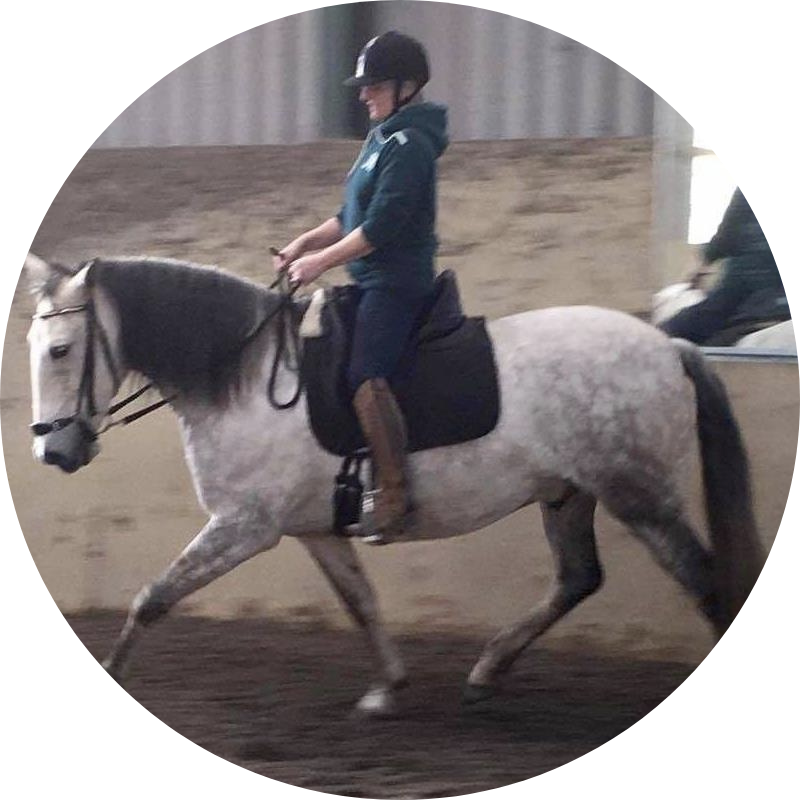
I feel as if this course began at ABC and went right through to XYZ. Thomas and Shana share ALL their knowledge and not just little titbits of information that still leaves you in the dark wondering why something you are doing isn't working for you and your horse and making you feel like you are a useless rider. They don't just advise 'try shoulder in' to help you with an unbalance in your horse...they tell you EXACTLY how, why and what for in SUCH fine detail they leave you with no doubts about what you are doing, why and how it will help you and your horse. This course builds into a detailed encyclopaedia of how to ride and train your horse, no matter what discipline you enjoy, that you can refer to for years to come.
- Carol Kosy, NE Somerset, UK
The course has provided a huge amount of technical detail, in an easily accessible format. The exercises are explained in careful detail with variations depending on your and hour horse's level of experience. Although I have done this course with a young horse who certainly can't do the complicated stuff, he has improved and I have a far better understanding of what we are trying to achieve, and tools to use to achieve that understanding.
- Jean de Klerk, South Africa
Take this course!!! It has changed not only my relationship with my horse but has honestly restored my faith in people too. I have never felt more supported and less judged in my dressage career of 25 years. Not only are Shana and Thomas amazing but the people in the course have been wonderful also. I have learned so many important and sensible things, most importantly how to effectively half halt my horse by FINALLY knowing where his feet are! Can't say enough about this experience, just plain fabulous.
- Maureen Shinsky, Michigan USA
This online-riding course is the best you can choose right now! My hopes to find out how to transfer classical dressage movements practised from the ground into the ridden work with my young horse have been fulfilled completely. Thomas and Shana Ritter have been able to define exactly what happens biomechanically when we start to ride and want to gymnastize our horses from the saddle in a sound and profound manner. They have come up with numerous creative exercises for classical movements from easy to difficult to guide our horses fluently from relatively new under saddle towards more balance and then further through advanced exercises which in the end will lead to collection and with that the beauty of riding our horses lightly because they have learned how to carry a rider with strength and suppleness using the power of the hindlegs.
- Nan Brünig, Germany
Are you ready to learn the What, Why, and How of Training your Horse?
HERE'S THE TRUTH...
Every method of learning doesn’t work for every rider.
For as many riders who can learn just by watching and doing, or being told to just “shut up and ride,” there are just as many riders who need to think and understand BEFORE they can do it.
They NEED to know what to do, why to do it, and how to do it. They need to know what is going on in their horse or their body, they need to know why that is happening, and they need to know how they can change it.
IF YOU HAVE BEEN FRUSTRATED...
If you have been frustrated trying to cram your “square peg” way of learning (not saying YOU are square)
into a “round” hole and wondering WHY you have not been able to make progress like this…
IF YOU HAVE BEEN SHAMED...
If you have been shamed for asking too many questions purely just in an attempt to thoroughly understand something…
IF YOU'RE LOSING FAITH...
If you have started to lose faith in your ability because it doesn’t seem as “figureoutable” as you thought it would be…
IF YOU HAVE WONDERED...
If you have started to wonder if this whole riding thing is even something you were cut out for…
THEN LET US ASSURE YOU...
the only reason it has not worked for you YET is because you needed to find a method that works for your brain and the way you think and learn. This is good news, because it means the breakthroughs you have been waiting for you are just around the corner.
Let us help restore your faith in your ability to learn, your ability to understand, your ability to figure this out, and your ability to train your horse.
Or even if nobody has made you feel bad for being the curious, inquisitive, and studious learner you are, you can BOOST what you are already doing and take your learning to a whole ‘nother level.
We’ve broken the entire system down and given away all of our secrets so you, too, can become part of the Thinking Rider Revolution.
Let’s get started.
X Shana

In this course, there aren't just instructions, how to ride a specific exercise, like you're getting them elsewhere. You get all the background, why to ride a specific exercise at a specific point of education and what should be achieved with this exercise. And of course, there are also explanations on how to improve the exercises. But every hint or suggestion comes with an background explanation, so that every course participant learn to think and not just follow instructions. This online course was the best thing, I ever did for my riding development!
- Sandra Schindlbacher, Austria
I find that this course has given me a thorough understanding of how I can work with my horse in a healthy way. I have learned what questions to ask in order to find out, and actually get, answers when things feel wrong. It has also given me a confidence as a rider which a haven’t felt before. This has made the communication between me and my horse almost tangible. My horse has gone from having a stiff side, headstrong and often unwilling to work to being in balance and a horse that wants to work. That is simply awesome. I really want to emphasis Shana and Thomas ever present and invaluable support and I really appreciate your enthusiasm. This course is simply great.
- Alexandra Westermark, Lidingö Sweden

The What, Why, How Program with Ritter Dressage - artisticdressage.com - All Rights Reserved - Terms & Conditions